Creating Manufacturable Blueprints for Coarse-Grained Virtual Robots
Automating the step from a freely evolved virtual body to a blueprint a builder can follow.
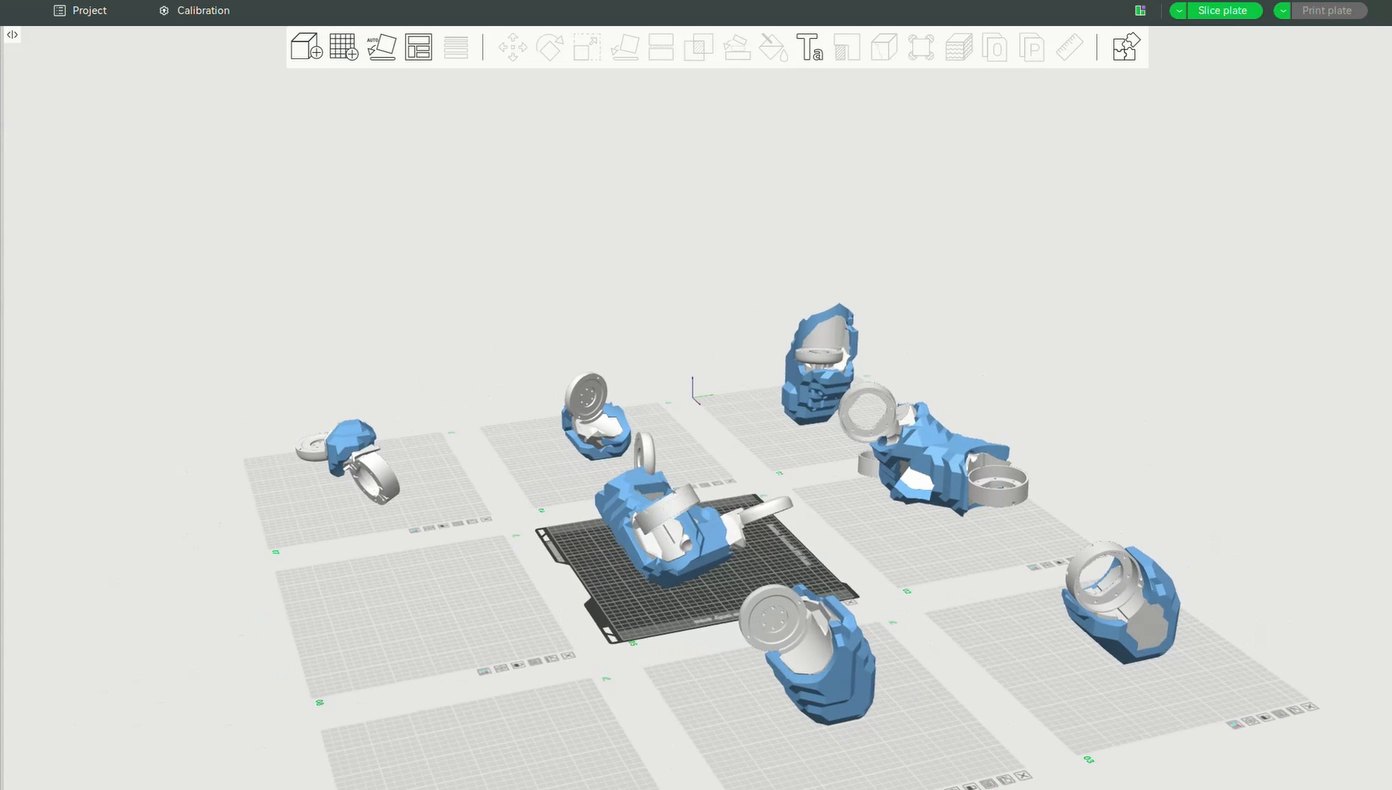
An evolved tripedal design, carried through the pipeline into printable files, then printed, assembled and switched on. It walks under the policy trained in simulation, transferred zero-shot with no tuning on hardware.
#Abstract
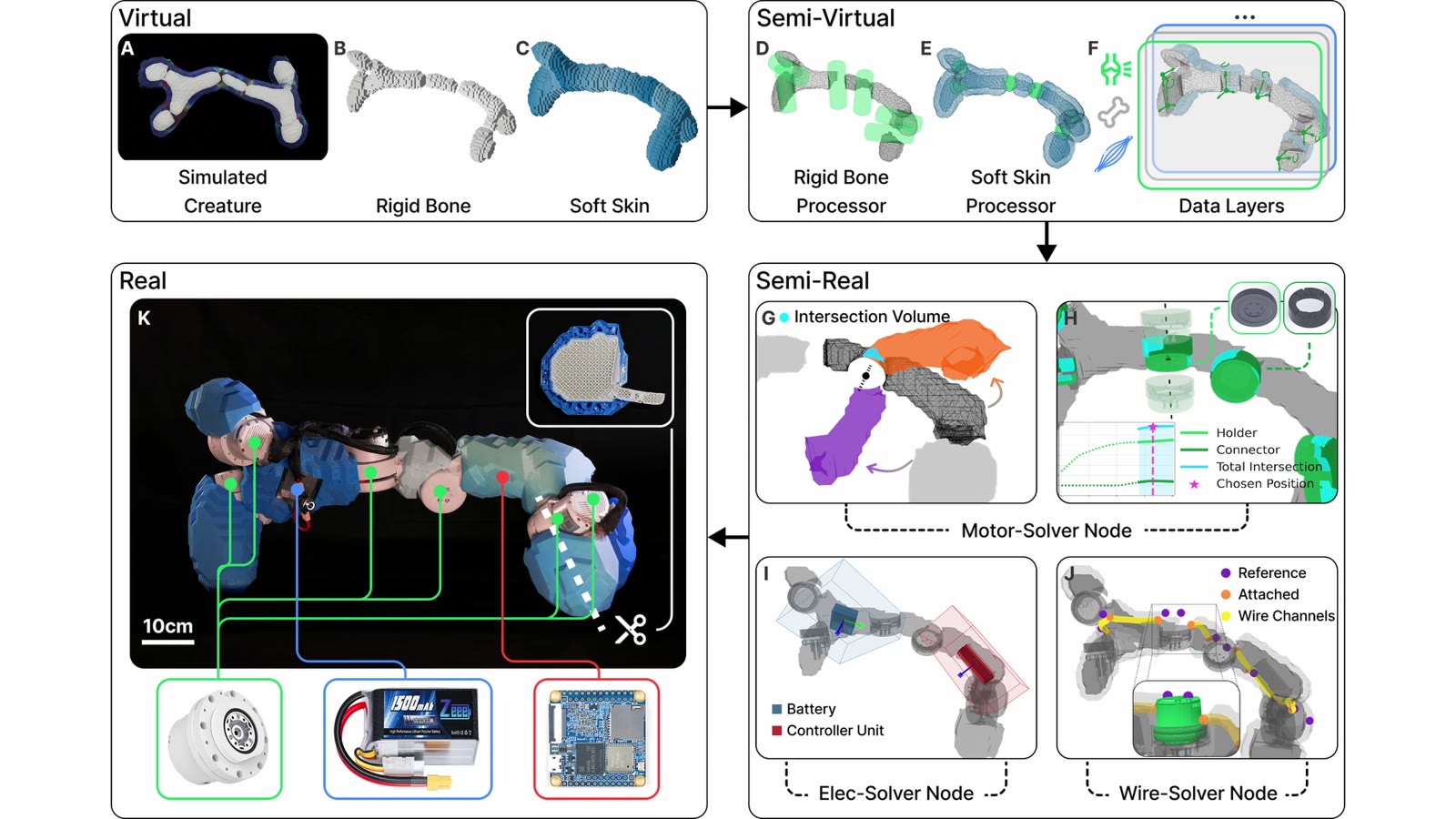
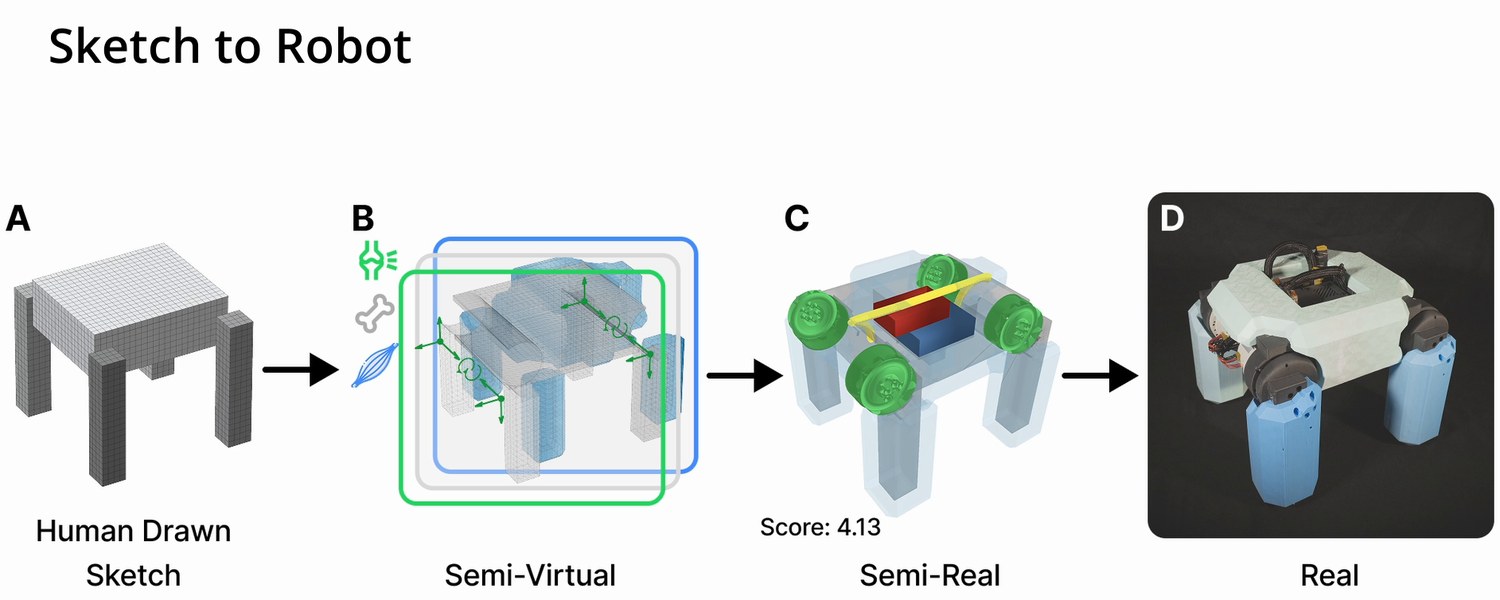
Over the past three decades, countless embodied yet virtual agents have freely evolved inside computer simulations, but vanishingly few were realized as physical robots. This is because evolution was conducted at a level of abstraction that was convenient for freeform body generation (creation, mutation, recombination) but swept away almost all of the physical details of functional body parts. The resulting designs were crude and underdetermined, requiring considerable effort and expertise to convert into a manufacturable format. Here, we automate this mapping from simplified design spaces that are readily evolvable to complete blueprints that can be directly followed by a builder. The pipeline incrementally resolves manufacturing constraints by embedding the structural and functional semantics of motors, electronics, batteries, and wiring into the abstract virtual design. In lieu of evolution, a user-defined or AI-generated “sketch” of a body plan can also be fed as input to the pipeline, providing a versatile framework for accelerating the design of novel robots.
#Method
A body that evolution is free to reshape has to be cheap to describe, so it is described as voxels and nothing else. A body a printer can build has to say where every motor sits, where the controller and battery live, and how each wire reaches them. The pipeline closes that gap in stages rather than in one step, so each stage has only one kind of constraint to satisfy.
#Results
Across 1,000 randomly sampled designs, 67% passed every solver stage, which measures how much of a freely evolved design space the pipeline can actually reach. One evolved tripedal design was taken the whole way, printed, assembled and run under its simulation-trained policy. It walked with zero-shot transfer, and that run is the clip at the top of this page.
#Citation
@article{guo2026blueprints,
  title   = {Creating Manufacturable Blueprints
             for Coarse-Grained Virtual Robots},
  author  = {Guo, Zihan and Li, Muhan and Zhang, Shuzhe
             and Kriegman, Sam},
  journal = {arXiv preprint arXiv:2603.13582},
  year    = {2026}
}